



When selecting a filter, many people ask, “What is the filtration area of this unit?” However, “filtration area” is not simply a matter of length multiplied by width.
Depending on the context, it might refer to the flat surface area of the filter’s windward side, the total unfolded area of the pleated filter media, or the “effective” area—that is, the portion of the media actually involved in the filtration process with an even distribution of airflow.
Miscalculating this area can lead to excessive face velocity, increased resistance, and insufficient dust-holding capacity; it may even prevent the fan from maintaining the designed airflow volume.
I. First, clarify: which type of area are you trying to calculate?
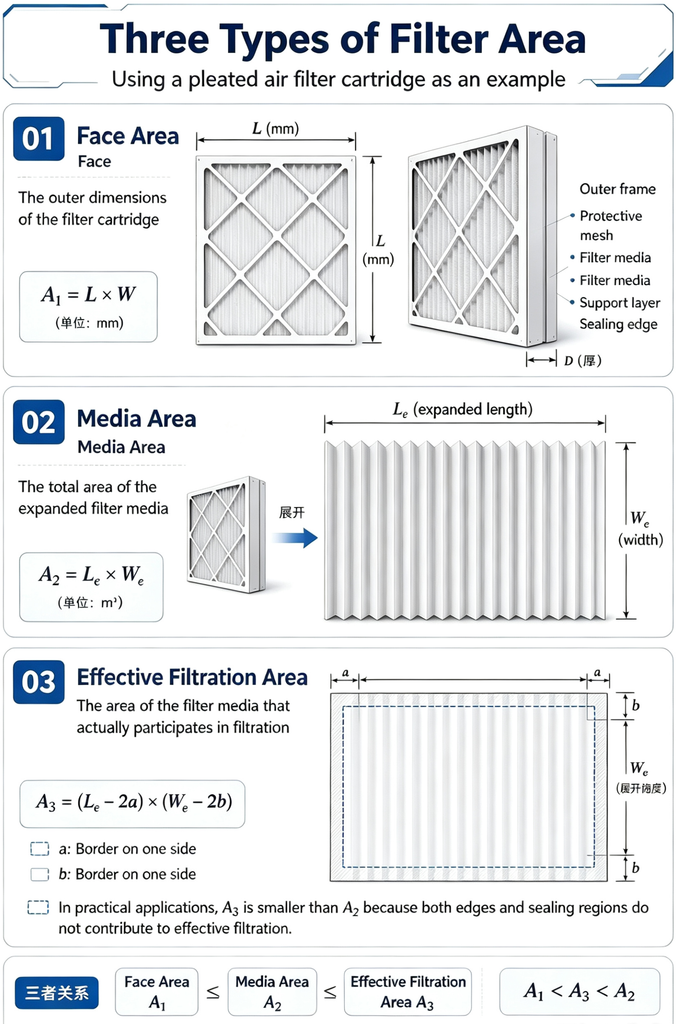
1. Face Area:
The face area is the geometric area of a filter’s upstream (windward) side.
It is typically calculated using the formula: Face Area = Length × Width. For example, a 592 mm × 592 mm filter has a face area of approximately 0.35 m².
This value serves as a basis for determining installation dimensions and calculating face velocity.
2. Expanded Media Area: In pleated filters, the filter media is processed into continuous folds;
when unfolded, its total area exceeds the face area. The expanded area depends on factors such as the height of the media, the depth and number of the pleats, and the specific pleating configuration.
3. Effective Filtration Area:
The effective filtration area is not merely the sum of the theoretical expanded area; it must be adjusted by excluding portions occupied by the frame, separators, adhesive, “dead zones,” and areas affected by uneven airflow distribution. Ultimately, it is the portion of the filter media through which air can consistently and effectively pass that determines the filter’s performance.
II. What is the most critical formula relating airflow volume to surface area?
In engineering practice, the following relationship is commonly used:
Face Velocity = Airflow Volume ÷ Face Area.
If airflow volume is expressed in m³/s and area in m², the result is in m/s; if airflow volume is in m³/h, it must first be divided by 3,600 to convert it into m³/s.
For example, if the system airflow is 3,600 m³/h and the filter face area is 0.35 m², the calculation is: 3,600 ÷ 3,600 ÷ 0.35 ≈ 2.86 m/s. This represents the geometric face velocity; whether this value is appropriate depends on factors such as the filter type, the structure of the filter media, the rated face velocity, and the resistance curve.
Conversely, if a target face velocity is known, the required face area can be calculated: Required Face Area = Airflow Volume ÷ Target Face Velocity.
This serves as a key basis for determining filter dimensions and the number of units to be installed in parallel.
III. Why does a greater pleat depth not necessarily result in more effective surface area?
While pleating increases the surface area of filter media within a confined installation space, deeper or more numerous pleats are not always better. If the spacing between pleats is too narrow, airflow may not be able to penetrate the deeper layers of the media uniformly.
Inadequate support can lead to pleat collapse, deformation, or localized “short-circuiting” (where air bypasses the media) during operation.
Furthermore, if an excessive portion of the filter area is occupied by adhesive beads or separators, the theoretical total surface area will not be fully converted into effective filtration area.
Therefore, when comparing two pleated filters, one should not simply ask, “What is the total surface area of the unfolded media?”
Instead, consider the following:
pleat depth and spacing; the design of media support and separators; the uniformity of airflow across the upstream face; initial and final pressure drop; and dust-holding capacity in relation to the actual replacement interval.
IV. How should the surface area of bag, pleated, and V-bank filters be understood?
Bag filters
increase the surface area of the filter medium through the use of multiple filter bags. The number of bags, their depth, the tension applied to them, and the distribution of airflow all influence the effective surface area. Greater depth is not necessarily better; excessively deep bags can lead to issues with airflow distribution and maintenance access.
Pleated filters
utilize folds to increase the total unfolded surface area, which helps to enhance dust-holding capacity and reduce face velocity within a limited footprint. In these designs, it is important to consider the stability of the pleats and the support provided to the filter medium.
V-type filter
incorporate multiple filter media units into a V-shaped configuration, allowing for a large unfolded surface area within a relatively shallow installation depth; they are commonly used in systems requiring high airflow or high levels of cleanliness. When calculating surface area, one should refer to the rated airflow and resistance curve of the entire unit, rather than simply summing the surface areas of the individual filter media components.
V. A Simple Case Study:
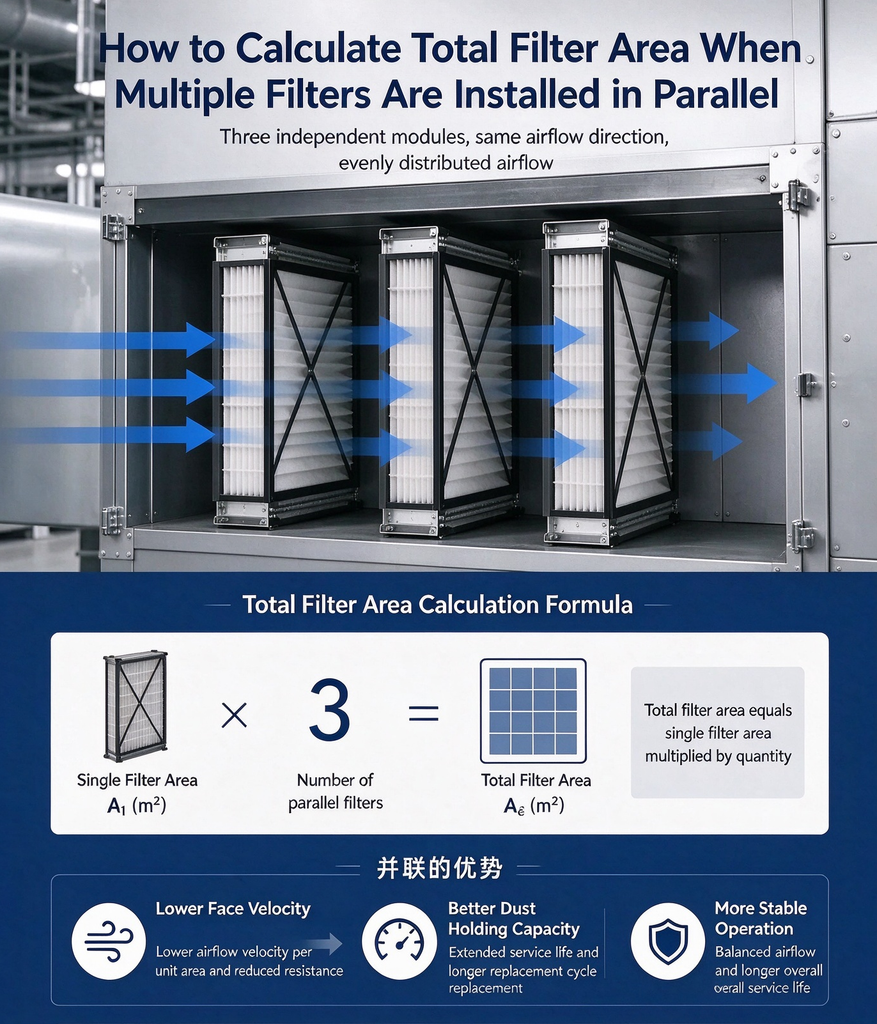
Why Does Increasing the Number of Filters Reduce Resistance? Suppose a system has a total airflow of 7,200 m³/h, and each individual filter has a frontal area of 0.35 m².
If only 2 filters are installed, the total frontal area is 0.70 m²; if 4 filters are installed, the total frontal area becomes 1.40 m².
With the total airflow remaining constant, the average face velocity in the 4-filter configuration is approximately half that of the 2-filter configuration.
A lower face velocity generally results in more favorable filter resistance; it may also improve airflow stability, dust-holding capacity, and operational noise levels.
However, increasing the number of filters affects equipment space requirements, initial investment, the number of sealing points, and maintenance workload—factors that necessitate a full-lifecycle comparison.
VI. A 6-Step Method for Calculating Filtration Area On-Site:
1.Determine the system’s design airflow and actual operating airflow;
2.measure the available length, width, and installation depth within the filter housing;
3.calculate the face area of an individual filter;
4. determine the total required face area based on the target face velocity;
5.establish the number of filters required by considering structural constraints, rated airflow, resistance, and dust-holding capacity;
6. and verify the calculations using on-site pressure differential, airflow, and maintenance records.
It should be noted that such calculations cannot replace formal product performance testing. Final selection must always be based on the rated airflow, initial resistance, final resistance, efficiency, and test conditions provided by the supplier.
VII. What factors should be considered when selecting Dayu products?
For primary-efficiency pleated filters, focus on the face area, pleat structure, and initial resistance. For F8 medium-efficiency bag filters, prioritize the number of filter bags, effective filtration area, rated airflow, and resistance characteristics.
For high-efficiency filters, evaluate the effective filtration area, sealing integrity, leak-testing, and rated airflow.
In specialized operating conditions—such as high-temperature environments, painting/coating processes, or areas with oil mist—it is essential to also verify the suitability of the filter media, frame, adhesives, seals, and the specified operating temperature range.
A larger surface area does not automatically guarantee suitability; a system will only operate stably when the filtration area, airflow, resistance, and specific operating conditions are all properly aligned.
While surface area serves as a starting point, the true objectives of calculating filtration area are to determine airflow and resistance.
The goal is not merely to arrive at an impressive figure in square meters, but to assess whether a filter can maintain an appropriate face velocity, manageable resistance, and a sufficient service life under the design airflow.
By distinguishing between flat surface area, unfolded (total) area, and effective filtration area—and by considering factors such as airflow, structural design, efficiency, and maintenance requirements—you can make truly reliable selection decisions.
If you are currently verifying the surface area of a filter, please feel free to leave a message on our official website, providing details regarding airflow, dimensions, filtration grade, and the filter’s construction.